


About The Author

About The Author
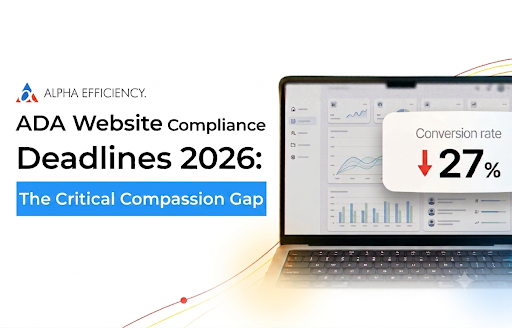
Your Conversion Rate Specialist is a scammer. He’s got you A/B testing red buttons against green ones. Debating hex codes. Running a 6-week test to lift conversion 0.4% (ignoring 27.6% of your total traffic nobody talks about).
And here I am, colorblind, unable to tell his red button from his green one.
While he chases decimals, 27.6% of your total traffic that can’t fully use your site at all. The largest demographic you serve, and it’s not even on his heatmap.
This is the compassion gap nobody talks about.
The blind patient whose screen reader hits a button labeled “image1.jpg.” The low-vision user who can’t read your gray-on-white form. The person with a tremor who can’t tab through your intake flow.
They don’t rage-quit. They don’t email. They close the tab and book with your competitor.
In your analytics, they look identical to everyone who “just didn’t convert.” So your CRO guy never sees them. He optimizes the 72% who were already fine and calls it a win.
Here’s what he won’t tell you: fixing accessibility is conversion optimization.
Real alt text.
Labeled forms.
Keyboard navigation.
Color contrast that works for the 1 in 12 men who are colorblind.
Every one of those fixes lifts revenue AND lets a real person use the thing you built to serve them.
Capitalism doesn’t have to be ruthless to be profitable. Do right by the 27.6%, and you win the conversion, the ranking, and the patient. Same line of code.
Your CRO specialist is testing button colors at a patient who can’t see colors.
Fix the gap he’s pretending isn’t there.
Reply “compassion” and I’ll send you a free report showing exactly which surfaces on your site are turning patients away today, and the order to fix them.
No pitch. Just the gap, and a way to close it.
The accessibility rule healthcare providers plan around lives inside Section 504 of the Rehabilitation Act. HHS finalized it in May 2024. The current accessibility deadlines:
WCAG 2.1 Level AA is the technical standard. Scope is everything users see and use: web content, mobile applications, the patient portal, intake forms, telehealth platforms, embedded third-party widgets, kiosks, and any social media posts that count as program content under the rule.
Healthcare providers that receive federal funding (Medicare, Medicaid, HRSA, NIH, CDC) fall under this category. HHS estimates 92% of US doctors, and every hospital qualifies. Cash-only and concierge practices fall under Title III of the original ADA, which means they can still face an accessibility lawsuit or demand letter under reasonable accommodation case law that has been in place since 1990.
That is the legal framing. Now the part Alpha cares about: every line of WCAG 2.1 Level AA maps to a conversion lift on a healthcare site that has been losing 1 in 4 patients to bad UX for years.
Three patients. Three real failure modes we see every month on healthcare provider sites. Each one ends in dollars.
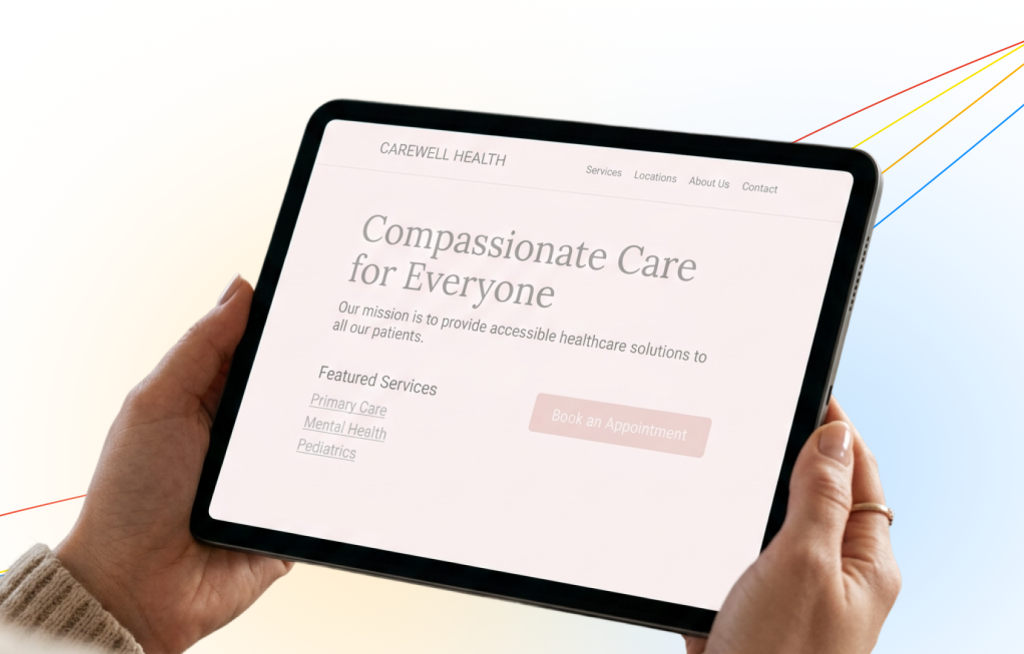
Patient A: blind, uses a screen reader. Lands on your homepage. Hero image of your three smiling partners. Alt text reads “image1.jpg.” The “Book Appointment” button is a styled <div> with no label. The screen reader announces “clickable.” She closes the tab and books with your competitor whose button is labeled. The acquisition cost for that lost patient was $42 in paid search.
Patient B: low vision, uses 200% browser zoom. Opens your patient portal login. Pale gray labels on white. Zoom breaks the layout, and “Forgot password” slides under the header. He gives up and calls the front desk. That call costs you $7.40 to handle. Multiply by 200 calls a month that should have been self-service, and you are spending roughly $17,760 a year on calls that a properly built portal would have prevented.
Patient C: hand tremor, cannot reliably use a mouse. Tries to schedule via your intake form. The custom dropdown component skips keyboard input entirely. She drives to an urgent care clinic with a better form. You will never know she was on your site.
People with disabilities make up roughly 27% of US adults, the largest single demographic any practice serves. Most healthcare provider sites fail them within three clicks. Web accessibility is the difference between converting that 27% and treating them as a rounding error. It shows up at the top of every CRO audit we run on a healthcare site.
AI Overviews have gutted organic CTR across every search vertical. One number stands out: brands cited inside an AI Overview see organic CTR rise by 35% while the rest of the click curve collapses. Citations are the new ranking, and the content most likely to win them is structured, semantic, and accessible.
Accessibility and SEO solve the same problem from two angles. A search crawler and a screen reader both need to parse your page without seeing it. The exact code that makes your site usable with assistive technology is the same code that makes it readable by Google.
Four overlaps that move the SEO needle:
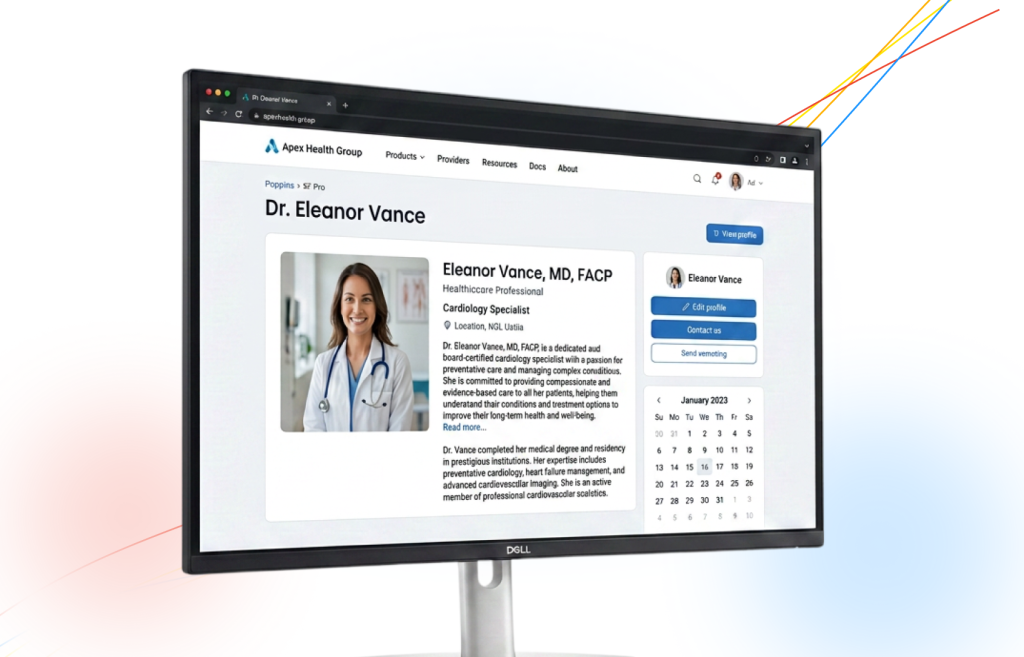
I have watched healthcare clients double their image search traffic just by writing real alt text across their bio pages and procedure photos. Digital accessibility done right is the cheapest SEO investment a healthcare site can make. The compliance deadline pays for the SEO upgrade you have been deferring while Google’s click economy gets rebuilt around citations.
80% of WCAG 2.1 Level AA findings reduce to five issues. Fix these, and you have closed the largest gaps before your audit even starts.
| Fix | What it costs | What it earns |
|---|---|---|
| Real alt text on every meaningful image | ~2 hours per 100 images | Image search traffic, AI Overview citation eligibility |
| Color contrast pass on brand colors | ~$400 design pass | Better readability for everyone, fewer support calls |
| Keyboard navigation on every interactive element | ~1 sprint of dev work | Lower abandonment on appointment booking flow |
| Form labels in code, not just visual | ~3 hours per form | Higher portal login success, less front-desk call volume |
| Clean heading structure across the site | ~1 content audit | Featured snippets and AI Overview citations |
Most healthcare sites we audit miss four of the five. Closing them, in order, takes 4 to 8 weeks for a small practice and 12 to 16 weeks for a multi-location group. Hit those five before the ADA website compliance deadlines 2026 land, and you have shipped the highest-leverage 80% of the standard at the lowest risk.
The patient portal is the conversion bottleneck nobody at the practice owns. Patients land on your domain, click “Patient Portal,” and immediately leave your site for a vendor-hosted login on a subdomain you have never opened in a screen reader. That subdomain is still your liability under Section 504 and still your conversion funnel.
Most portal vendor contracts say nothing about accessibility. The vendor ships what they ship, you pay for it, and your patients abandon it at the login screen. Two clauses to add at your next renewal:
A practice we worked with cut portal abandonment by 28% in 90 days by forcing their vendor to fix three labeling bugs on the login screen. The vendor had been quietly breaking that flow for two years. Nobody had complained, because the patients who could not log in did not bother to email about it. They just called the front desk.
A vendor has emailed you a one-line fix. Drop a script tag in your footer. A floating icon appears. Patients click it, pick high contrast or larger text, and the vendor claims you are now compliant.
It does not work. Three reasons:
The math: $49 a month buys you 12 months of degraded conversion, zero legal protection, and a flag on every plaintiff firm’s scraper list. Close the deck. The same logic applies to anyone pitching you a turnkey AI website design that promises accessibility, SEO, and conversion out of the box.

Reverse-engineer the ADA website compliance deadlines 2026 from May 11, 2027, and the year looks like this:
The trap is the coordination, not the engineering. Your portal vendor will not move on your timeline. Your marketing team is publishing new social media content every week. Start in the next 30 days, even if the bigger plan is not ready. A one-page scope document beats a Q4 panic.
Patient A, Patient B, and Patient C are why this practice exists. Alpha Efficiency runs accessibility audits and full remediations for medical practices, multi-specialty groups, and behavioral health platforms across the country. Three principles move every engagement:
Best practices in this field are well-documented and unevenly applied. We apply them in the order that protects your conversion first and your compliance second, because the deadline is the calendar and the conversion is the money.
If your May 2027 plan is still living on a Post-it, schedule a call. Twenty minutes, no pitch deck. You walk away with the specific surfaces that are bleeding patients today, the order of operations to fix them, and a number you can hand your CFO without flinching.
Yes, if you take any federal healthcare funding (Medicare, Medicaid, HRSA, NIH, or CDC). You fall under Section 504 and must meet WCAG 2.1 Level AA on your website, patient portal, and mobile app by May 11, 2027. Cash-only practices fall under Title III of the ADA, which has no fixed deadline but still leads to accessibility lawsuits today.
WCAG 2.1 Level AA is the technical standard for web access used in the HHS rule and most digital accessibility regulations worldwide. Content must be perceivable, operable, understandable, and robust (meaning it works reliably across browsers and assistive tech). In practice, that means alt text, keyboard navigation, color contrast, labeled forms, and clean heading structure across web and mobile applications.
No. Overlay widgets that promise instant compliance have been rejected by courts and HHS as a stand-alone defense. They cannot fix alt text quality, keyboard navigation, color contrast in your real brand, or third-party patient portal accessibility. Plaintiff firms now filter targets by overlay script signatures, so an overlay can actively mark you for litigation.
A small practice audit runs $4,000 to $15,000. Remediation depends on site complexity, from $10,000 for a five-page brochure site to $150,000 or more for a multi-location group with custom patient portal work. Most healthcare providers budget the total project cost at one to three percent of annual marketing spend.
Yes. The HHS rule explicitly covers web content, mobile applications, the patient portal, even when operated by a third-party vendor, kiosks, and covered social media posts. Your contracts with portal and app vendors should require WCAG 2.1 Level AA compliance and provide documentation you can produce if a complaint arrives.
Recent Post
Brian Dordevic
Elements of a Good Website (Beyond the Fancy Animations)
READ MORE
Brian Dordevic
You’ll Regret Skipping Web Design Quality Assurance
READ MORE
Brian Dordevic
HubSpot CMS vs WordPress Isn’t a Debate (How High-Growth Teams Use Both)
READ MORE