


About The Author

About The Author
If you’re looking into HubSpot CMS vs WordPress, you probably already know the basics.
You understand what a CMS is.
You know both platforms are respected.
You’ve probably read enough comparison articles to notice they all sound the same and rarely give a real answer.
Because the question isn’t which CMS is better.
The real question shows up later…
That’s where most HubSpot CMS vs WordPress advice stops being useful.
Not when you’re choosing software, but when scale reveals what actually breaks.
This is the big challenge when choosing a CMS:
Which setup continues to work when growth is no longer hypothetical?
Not just about picking a CMS.
It’s about finding a system that scales smoothly, keeps your teams aligned, and turns attention into revenue as volume increases.
At Alpha Efficiency, we work with companies that have already moved past surface-level comparisons.
They publish consistently.
They invest in SEO and lead quality.
They run real marketing operations.
But most importantly, they want clarity on what actually drives revenue, not just traffic.
And across those engagements, we see the same pattern repeat.
The most resilient, highest-performing websites are not built by choosing HubSpot CMS vs WordPress.
They’re built by using both.
In this post, I’ll break down how high-growth companies combine HubSpot CMS with WordPress Development to leverage what matters and ensure stability where it counts.
WordPress brings demand. HubSpot tells you what converts and why.
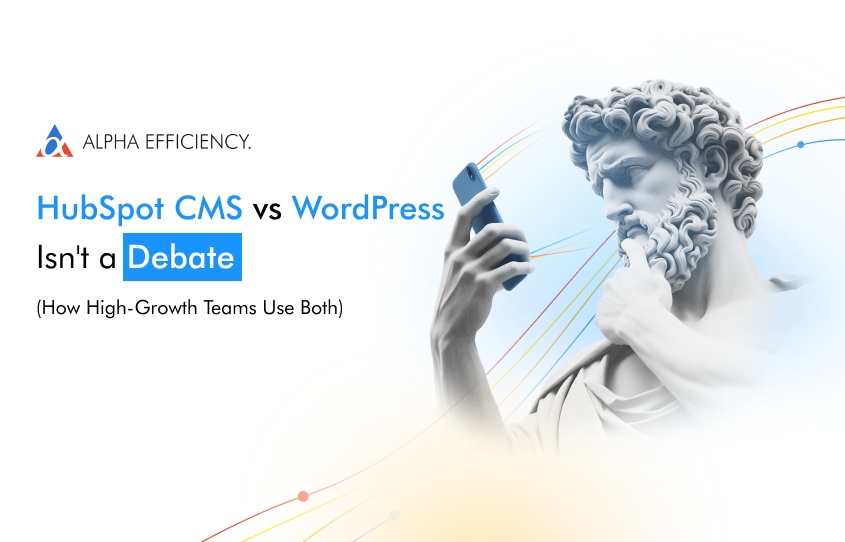
Most HubSpot CMS vs WordPress comparisons are written like product reviews.
They focus on:
Those factors matter, but only at a surface level. They describe tools, not outcomes.
What they fail to address is what actually breaks as a business grows…
Websites don’t fail because the wrong buttons exist. They fail because the underlying architecture can’t support scale.
A CMS is not just a place to publish pages.
It’s the foundation for how traffic, data, content, and conversions interact across your entire marketing system. It dictates how teams collaborate, how fast changes can be made, and how reliably performance holds up under pressure.
When the foundation is misaligned, problems don’t show up immediately.
They surface later, when traffic increases, campaigns multiply, and complexity compounds.
That’s when CMS decisions become expensive.
Because switching platforms at scale often means:
This is why the real HubSpot CMS vs WordPress comparison isn’t about features.
The key question is whether the system you choose today will still perform when growth becomes operational.

To begin with, everything feels simple.
One login.
One system.
Everything is contained, efficient, and easy to manage.
That simplicity is exactly why most teams start with a single platform when comparing HubSpot CMS vs WordPress.
Fewer tools.
Fewer decisions.
Less friction.
Early on, this works.
But as growth kicks in, the rules change.
Suddenly, the website is expected to support:
At that point, expectations outgrow the platform.
No CMS can do everything it’s asked to do equally well.
Underneath most HubSpot CMS vs WordPress debates is an unspoken assumption: there should be one perfect system.
In practice, that assumption is what creates the problem.
When teams try to force a single platform to handle fundamentally different jobs, the same issues appear every time:
This isn’t a WordPress problem.
It’s not a HubSpot problem either.
The real issue is asking one system to behave like two.
One built for flexibility and scale.
One built for orchestration, data, and lifecycle control.
And that’s where the HubSpot CMS vs WordPress conversation usually goes wrong.
WordPress powers a massive portion of the web, and that’s not an accident.
It was built for content as infrastructure, not as a side feature.
WordPress excels at:
For companies serious about organic traffic, topical authority, content clusters, and long-term search visibility, WordPress remains one of the most flexible and scalable platforms available.
WordPress doesn’t force you into a predefined growth model. It gives you the freedom to build one.
And in the broader HubSpot vs WordPress comparison, WordPress stands out as the best visibility engine.
WordPress is exceptional at driving visibility.
But it was never designed to unify your entire marketing system.
Most WordPress-only setups rely on:
On paper, everything looks connected.
In practice, data lives in too many places.
But this is not a failure of WordPress.
WordPress can attract attention at scale.
What it struggles with is translating that attention into clear, lifecycle-level insight.
It can show you what is happening.
It has a much harder time showing why.
And that gap becomes impossible to ignore as growth accelerates.

The HubSpot CMS is built on an entirely different paradigm.
It was never designed to power blogs for millions of publishers.
It was built to connect content directly to outcomes.
In the HubSpot CMS vs WordPress comparison, this is the defining distinction.
HubSpot CMS is strongest when it comes to:
HubSpot doesn’t just tell you that a form was submitted.
It tells you:
That level of context changes how teams operate.
Marketing and sales stop debating lead quality.
Reporting shifts from activity to impact.
Decisions are made with shared data, not assumptions.
Unlike WordPress, HubSpot CMS is not built to publish massive volumes of SEO content at high velocity.
That limitation is intentional.
Large editorial operations and complex content hierarchies can feel restrictive inside HubSpot CMS.
But that restriction exists for a reason.
HubSpot CMS isn’t designed to publish more pages.
It’s focused on visibility into what is actually working, converting, and creating momentum.
And that’s exactly why it performs best as part of a broader architecture.
Not when it’s forced to be the only system.
But when it’s paired intentionally inside a HubSpot CMS vs WordPress strategy built for growth.

At Alpha Efficiency, we start with outcomes in mind, not platforms.
Instead of asking, “Which CMS should we choose?” we ask a different question:
What profit is this system supposed to produce?
Clear goals lead to smarter choices and overall better solutions and results.
This is not about stacking tools.
It’s about assigning each system a specific job and letting it excel.
That architectural shift is what allows companies to move past the limits of single-platform thinking and unlock measurable, sustainable growth.
Because growth doesn’t wait.
And competitors don’t pause while teams debate tooling.
| Capability | WordPress | HubSpot | Alpha’s Hybrid Strategy |
|---|---|---|---|
| SEO content scale | Excellent | Limited | Excellent |
| Editorial flexibility | High | Moderate | High |
| Conversion optimization | Plugin-based | Native | Native + Data-driven |
| CRM integration | External | Built-in | Built-in |
| Lead attribution | Fragmented | Strong | Strong + SEO-informed |
| Marketing automation | External tools | Native | Native |
| Content velocity | High | Moderate | High |
| Funnel visibility | Limited | Excellent | Excellent |
| Long-term scalability | Depends on setup | Strong | Strong + Flexible |
The main takeaway is that a combined system eliminates the tradeoffs most teams assume are unavoidable.
In a properly designed HubSpot with WordPress architecture, you’re no longer forced to choose between reach and results.
In short, WordPress handles visibility and scale. and HubSpot manages conversion and intelligence.
Most conversion problems aren’t caused by design or copy.
They’re caused by missing context.
Context means knowing:
Without that insight, everyone receives the same message.
Timing breaks down.
Momentum slows.
Conversions suffer.
When HubSpot CMS is part of the system:
Conversion rates improve not because pages look better, but because experiences become more relevant and intentional.

A common concern in HubSpot CMS vs WordPress discussions is whether using multiple platforms hurts SEO.
When the architecture is intentional, the opposite happens.
SEO becomes stronger.
Because:
SEO stops being a traffic vanity metric.
It becomes a growth signal.
With the right system in place, visibility and conversion no longer compete with each other.
They compound.
The real game-changer most teams miss is confidence.
As Joe Sugarman famously explained, people make decisions emotionally, then justify them with logic. Growth works the same way inside organizations.
In the HubSpot CMS vs WordPress debate, confidence is what most teams are actually lacking.
When WordPress and HubSpot CMS are used together, confidence becomes systemic.
Momentum replaces friction.
The real error is believing that one platform can do everything.
What feels simple now won’t hold you back later.
This way of thinking leads to problems that better copy or design can’t fix. Teams build SEO that brings in traffic but doesn’t convert, add conversion tools that don’t scale, and collect data that never turns into insight.
At Alpha Efficiency, we don’t argue about platforms or web design systems.
Every tool we use has a clear purpose, and the method simply works because each part does its job.
The CMS decision is an architectural problem, not a software debate. Websites don’t fail because of tools. They fail because systems aren’t designed to scale with growth.
No single CMS can do everything well at scale. Trying to force one platform to handle SEO scale, attribution, personalization, and revenue clarity leads to bloated setups and internal friction.
WordPress excels at visibility and SEO infrastructure. It’s unmatched for publishing velocity, content organization, and long-term organic growth.
HubSpot CMS excels at conversion intelligence. It connects content directly to CRM data, attribution, lifecycle stages, and personalization.
WordPress-only growth creates attribution blind spots. Traffic can grow while conversions stagnate because teams lack clear insight into what actually drives revenue.
HubSpot-only setups limit content scale by design. HubSpot prioritizes clarity and control over publishing velocity, which becomes restrictive for large SEO programs.
The highest-performing teams use both platforms together. WordPress handles scale and discovery; HubSpot handles conversion, context, and data.
Hybrid systems eliminate trade-offs. Businesses no longer have to choose between traffic and insight, reach and results, or SEO and conversion clarity.
Conversion problems are usually context problems. Personalization, timing, and lifecycle awareness matter more than design tweaks or copy changes.
SEO improves when revenue data guides content strategy. Conversion data reveals which keywords and pages actually drive business outcomes.
The biggest hidden benefit is organizational confidence. Marketing, sales, and leadership trust the data, align faster, and make decisions without second-guessing.
The real mistake isn’t choosing WordPress or HubSpot; it’s believing simplicity today won’t become a limitation tomorrow.

Choosing HubSpot CMS vs WordPress isn’t a competition.
When teams treat this as a head-to-head comparison, they usually end up optimizing for short-term simplicity instead of long-term performance. One platform is stretched to do everything, tradeoffs are accepted as “normal,” and inefficiencies quietly compound as the business grows.
That’s where most CMS strategies break.
Real efficiency shows up when teams stop forcing one system to handle every job and instead design an architecture where each platform does what it was built to do best.
At my web development agency in Chicago, we don’t sell platforms or push one CMS over another. We design systems around outcomes. Systems that scale traffic without breaking attribution. Systems that turn attention into revenue.
If you’re still asking which CMS is better, you’re asking too early in the process.
The real question is whether your current setup can support where your business is going next.
If you want a clear, outcome-driven recommendation, book a call with Alpha Efficiency. We’ll look at your current system, identify what’s holding growth back, and map a structure built to scale without guesswork.
Book a call if you want a clear recommendation based on your goals, not platform bias.
Recent Post
Brian Dordevic
Elements of a Good Website (Beyond the Fancy Animations)
READ MORE
Brian Dordevic
ADA Website Compliance Deadlines 2026: The Critical Compassion Gap
READ MORE
Brian Dordevic
You’ll Regret Skipping Web Design Quality Assurance
READ MORE